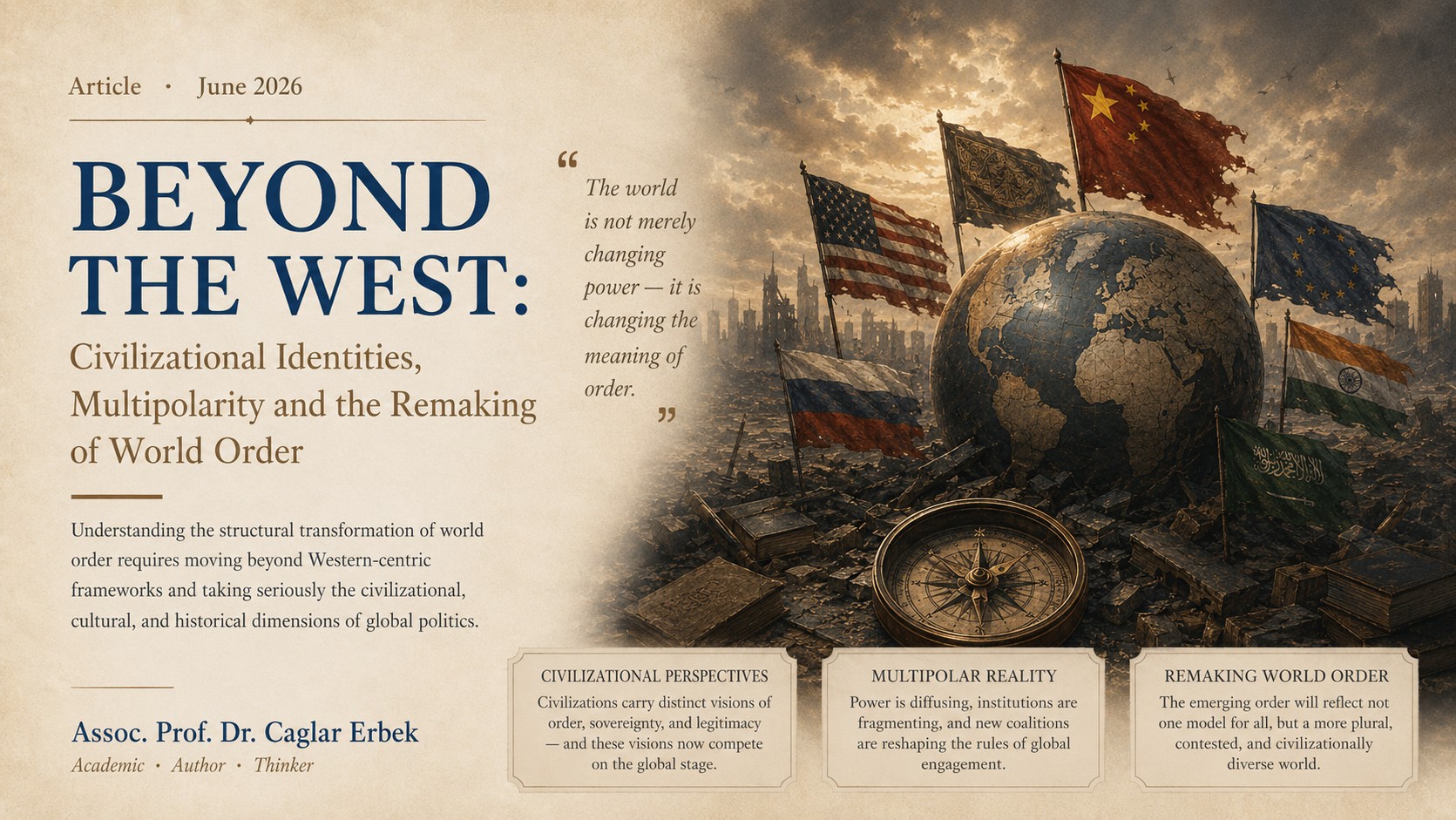
Beyond the West:
Civilizational Identities, Multipolarity and the Remaking of World Order
Assoc. Prof. Dr. Caglar Erbek · June 2026
ONLINE CONFERENCE LECTURE
Date: Monday, 1 June 2026
Time: 18:30 (UTC+3)
Format: Online — open to university students
Duration: ~60 minutes (lecture + Q&A)
Language: English
Website: caglarerbek.com
The world order constructed after 1945 is not merely in crisis — it is undergoing a structural transformation whose depth and direction remain fiercely contested. This article, which forms the intellectual basis of an online conference lecture to be delivered on 1 June 2026, argues that understanding this transformation requires moving beyond the frameworks of Western-centric international relations theory and taking seriously the civilizational, cultural, and historical dimensions of global politics.
I. The Fracture of Liberal Order
For over three decades following the end of the Cold War, the international system operated under a framework that its architects and defenders called the “rules-based international order.” Built on the institutional architecture of 1945 — the United Nations, the Bretton Woods financial system, and the norms of liberal multilateralism — and ideologically consolidated after 1991, this order rested on a set of assumptions that were, in practice, deeply Western: that liberal democracy was the universal endpoint of political development, that free markets were the natural medium of international economic relations, and that Western power was the legitimate guardian of global stability.
That order is now fracturing along three structural fault lines.
The first is geopolitical. The rise of China as a peer competitor to the United States has fundamentally altered the architecture of global power. Unlike the Soviet challenge, which was primarily military and ideological, the Chinese challenge is simultaneously economic, technological, normative, and institutional. The US-China rivalry is not a cold war in the classical sense — it is a contest over the very grammar of world order: who sets the rules, who enforces them, and whose vision of sovereignty, development, and legitimacy prevails.
The second fault line is normative. The universalist claims of the liberal order — human rights, democratic governance, the responsibility to protect — have been progressively hollowed out by the selective manner in which they have been applied. The contrast between the international response to the invasion of Ukraine and the decades of relative silence over comparable or worse situations in the Global South has not been lost on the governments and publics of Asia, Africa, Latin America, and the Middle East. The legitimacy deficit of Western-led multilateralism is now structural, not episodic.
The third fault line is institutional. The UN Security Council is paralysed by great power veto. The WTO dispute settlement mechanism has been effectively disabled. NATO is internally divided over the meaning and scope of its commitments. The Bretton Woods institutions — the IMF and World Bank — face sustained demands for governance reform from emerging economies that contribute significantly to global output but remain underrepresented in decision-making. The question is no longer whether these institutions will change, but whether they will be reformed from within or bypassed from without.
As Canadian Prime Minister Mark Carney observed at the World Economic Forum in Davos in January 2026, the current moment represents a “rupture” of world-historical significance — comparable in scale, if not in character, to the transitions of 1918, 1945, and 1989. The open question is what will emerge from that rupture.
II. The Civilizational Lens: Beyond Huntington
One theoretical response to the fracturing of liberal order has been a revival of civilizational thinking in international relations — a tradition associated above all with Samuel Huntington’s 1996 thesis, The Clash of Civilizations and the Remaking of World Order. Huntington argued that the post-Cold War world would be structured not primarily by ideology or economics but by cultural and civilizational identity — and that the “fault lines” between civilizations would be the primary sites of future conflict.
Huntington’s thesis has been widely criticised, and not without reason. His framework is too static — civilizations do not interact as monolithic blocs. It is too deterministic — cultural identity does not straightforwardly produce political behaviour. And it is too narrowly focused on conflict — it has little to say about civilizational cooperation, hybridity, or the transformative role of trade, migration, and cultural exchange.
Yet the dismissal of Huntington should not entail the dismissal of civilizational analysis as such. Recent scholarship — from Amitav Acharya’s concept of the “multiplex world” to Arta Moeini’s civilizational ontology of international relations — has sought to recover the civilizational lens while shedding its deterministic and antagonistic assumptions. The key insight is not that civilizations clash, but that they carry distinct visions of political order, sovereignty, and legitimacy — and that these visions are now competing on the global stage more openly than at any point since the era of Western colonial dominance.
From this perspective, the current moment is not simply a power transition — the replacement of one hegemon by another — but a civilizational transition: a shift in the normative and cultural foundations of world order itself.
Central to this article’s argument is a perspective that is rarely foregrounded in Western IR scholarship: the civilizational identity of the Turkic and Central Asian world. The Tengrist tradition — the pre-Islamic, pre-Christian spiritual and philosophical worldview of the Eurasian steppe — is not merely a historical artefact. It is a civilizational substratum that continues to shape political culture, conceptions of sovereignty, and collective identity across the Turkic world, from Anatolia to Central Asia and beyond. The contemporary resonance of Tengrist themes — the sacred bond between the community and the sky, the emphasis on balance between human society and the natural order, the rejection of rigid theological or ideological universalism — finds expression in ways that neither Western liberalism nor political Islam can fully accommodate.
The emergence of the Organization of Turkic States (OTS) as a soft civilizational power architecture — bringing together Turkey, Azerbaijan, Kazakhstan, Kyrgyzstan, Uzbekistan, and Turkmenistan under a framework of shared cultural heritage — is one institutional expression of this civilizational self-consciousness. BRICS, similarly, is better understood not merely as an economic grouping but as a civilizational coalition: a platform through which states that share a critique of Western normative hegemony — however different their domestic systems — can coordinate and amplify their claims.
III. Middle Powers and the New Grammar of Sovereignty
The transition toward a more multipolar world order has been accompanied by a significant shift in the behaviour and self-understanding of what IR scholars call “middle powers” — states that lack the resources to shape the international system on their own but are large enough to influence regional dynamics and to resist, selectively, the demands of great powers.
What distinguishes the current generation of middle power assertiveness from earlier episodes is its explicitly civilizational character. Countries like Turkey, India, Brazil, Saudi Arabia, and Indonesia are not simply pursuing traditional national interests within an accepted international framework. They are contesting the normative framework itself — claiming the right to define sovereignty, legitimacy, and development on their own terms, drawing on their own historical and cultural traditions.
Turkey offers perhaps the most analytically rich case study. It is a NATO member that purchased S-400 air defence systems from Russia, triggering a sustained crisis with its alliance partners. It served as a mediator between Russia and Ukraine in the early stages of the 2022 war, facilitating the Black Sea Grain Deal that temporarily preserved global food security. It has applied for partner status in BRICS, signalling a structural reorientation — or at least a structural hedge — toward alternative geopolitical centres of gravity. And it has articulated, through various formulations, a doctrine of strategic autonomy that resists reduction to either Western or Russian or Chinese alignment.
These moves are sometimes described as contradictory or opportunistic. But read through a civilizational lens, they are coherent: Turkey is asserting its right to a sovereign foreign policy that reflects its specific historical position — geographically between Europe and Asia, historically rooted in both Islamic and pre-Islamic Turkic traditions, and strategically located at the intersection of multiple regional systems. The question this raises for IR theory is significant: can the existing framework of international norms accommodate states that are structurally inside the Western order but civilizationally and normatively outside it?
IV. The Migration–Identity–Geopolitics Triangle
The fourth dimension of the current world-order transition is the relationship between mass migration, identity politics, and geopolitical competition — a triangle in which each vertex reinforces and reshapes the others.
Migration has been a permanent feature of human history. But in the contemporary moment, several factors have combined to make it a structural force in world politics rather than a peripheral humanitarian concern. The first is scale: the number of people displaced by conflict, environmental degradation, and economic precarity has reached levels not seen since the mid-twentieth century. The second is visibility: digital communications and social media have made migration flows — and the political responses to them — immediately and globally visible in ways that were impossible a generation ago. The third is instrumentalisation: states have increasingly learned to use migration flows as instruments of geopolitical pressure. Turkey’s management of Syrian refugee flows in relation to its negotiations with the European Union is perhaps the most extensively documented example, but it is far from the only one.
The political consequences of mass migration in receiving societies have been well documented: the rise of nativist and civilizationally-defined political movements across Europe and North America; the erosion of consensus around multicultural integration models; the deepening of fault lines between cosmopolitan urban elites and rural and working-class communities whose experience of migration is more immediate and less cushioned by economic privilege.
Less frequently examined is the ecological dimension. Climate change is already functioning as a migration multiplier — increasing the frequency and severity of droughts, floods, and other climate-related disasters that displace populations and generate pressure on receiving societies. The IPCC’s projections suggest that this dynamic will intensify dramatically over the coming decades. The question of who bears the burden of climate-induced migration — and on what normative and legal basis — will be one of the defining challenges of 21st-century international relations, and one for which the existing framework of international law is profoundly inadequate.
Finally, diaspora communities deserve attention not simply as objects of migration policy but as active agents in civilizational politics. Turkic diaspora communities across Europe, for example, are not merely immigrant populations navigating integration. They are participants in a complex triangulation between the host society, the country of origin, and a broader civilizational identity that neither national framework fully captures. Understanding diaspora politics as civilizational politics is one of the analytic tasks that a post-Western IR theory must take seriously.
Conclusion: Toward a Post-Western International Relations
The argument of this article — and of the lecture it accompanies — is not that Western IR theory has nothing to offer. Realism’s attention to power and interest, liberalism’s emphasis on institutions and cooperation, constructivism’s insight that norms and identities shape state behaviour: these remain indispensable analytical tools. The argument is, rather, that these tools were developed within a particular historical context — Western hegemony — and that their limitations become visible precisely in a moment of hegemonic transition.
A genuinely post-Western international relations theory would not simply add non-Western cases to existing frameworks. It would take seriously the possibility that non-Western civilizations carry their own theoretical resources — their own conceptions of order, sovereignty, legitimacy, and justice — that deserve to be engaged on their own terms. The Tengrist tradition, to take the example most relevant to this lecture, offers not a romantic nationalism but a philosophically substantive alternative to both Western liberalism and political Islam as frameworks for organising political community and understanding the relationship between human society and the natural order.
The world order is being remade. The question for this generation of students, scholars, and practitioners of international relations is not whether to engage with that remaking, but how — and with what conceptual resources, what ethical commitments, and what awareness of the civilizational diversity that makes the task both necessary and possible.
About the Author
Assoc. Prof. Dr. Caglar Erbek is a political scientist, cultural researcher, and author based in Izmir, Turkey. He has published eight books and contributes to academic journals on Tengrianism, Central Asian studies, global power dynamics, and education policy. He writes in Turkish, English, and Russian.caglarerbek.com