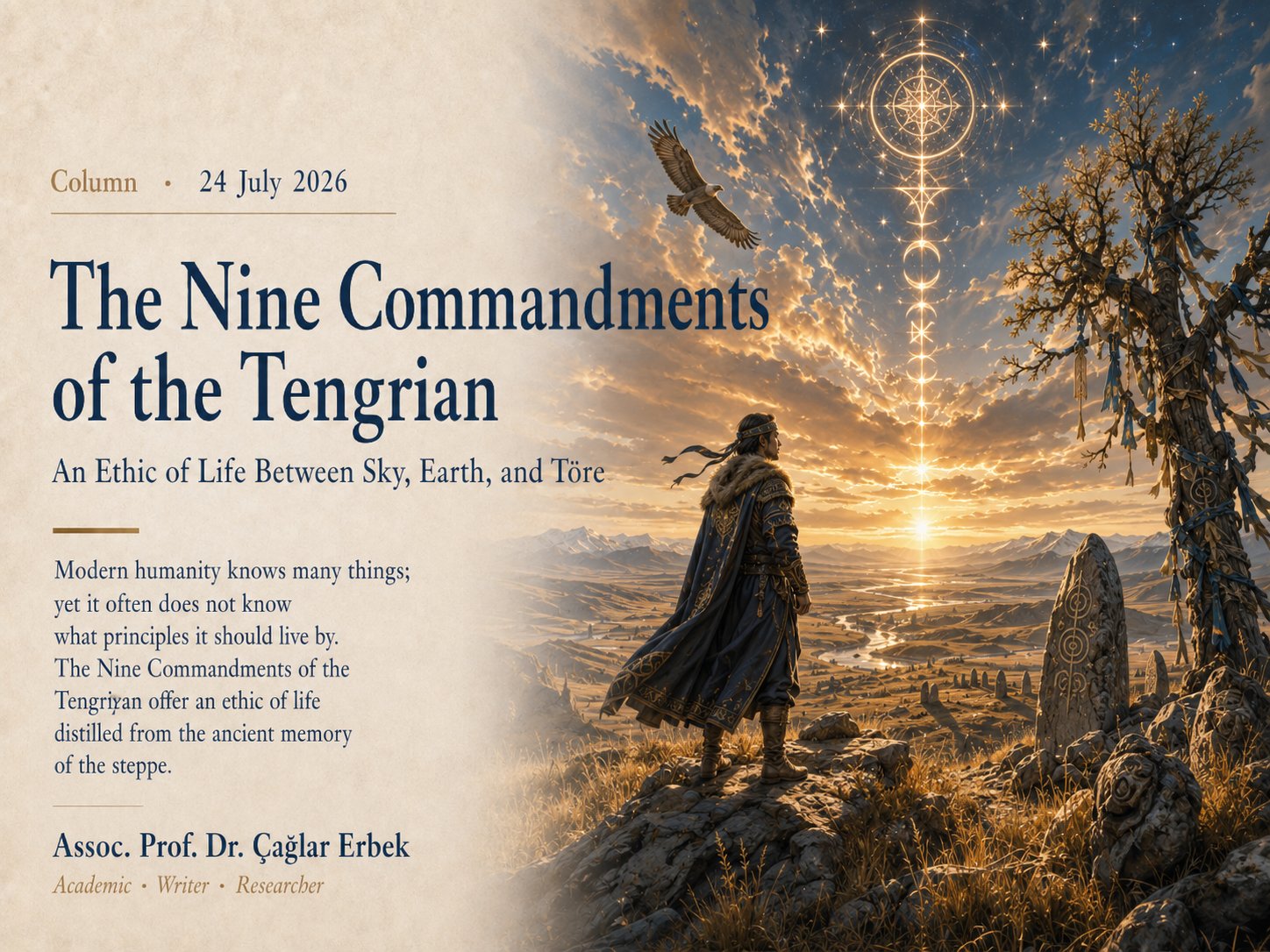
The Nine Commandments of the Tengrian
An Ethic of Life Between Sky, Earth, and Töre
Assoc. Prof. Dr. Caglar Erbek
Some words are more than advice; they are profound covenants a person makes with oneself. Some principles, likewise, are not merely memories inherited from the past, but compasses to be carried while walking toward the future.
The Nine Commandments of the Tengrian should be understood in this spirit: not as rigid decrees imposed by a belief system, but as an ethic of life distilled through thousands of years of memory from the Great Steppe.
Modern humanity knows many things, yet unfortunately often does not know by what principles it should live. Knowledge has multiplied, but wisdom has become scarce. Everyone speaks, yet the value of one’s word has diminished. Everyone speaks of freedom, yet responsibility is too often forgotten.
It is precisely here that Tengrian thought reminds us of an ancient truth that has never grown old:
The Sky is above us, the Earth is beneath us, and the human being stands between them as a responsible being.
The first commandment of the Tengrian therefore begins:
“You shall not forget Tengri; you shall look to the Sky and walk responsibly upon the Earth.”
This remembrance is not merely a religious act.
The Sky is where human beings learn their limits. One who looks upward acknowledges the existence of an order greater than oneself. One who walks upon the Earth remembers one’s duties within that order.
Humanity is not the master of the universe, but a conscious and responsible part of it.
When this distinction is forgotten, arrogance begins. And when arrogance begins, humanity enters into conflict with nature, society, and ultimately its own soul.
The second commandment concerns Töre:
“You shall live by Töre not only among others, but also when you are alone.”
Morality is not a performance displayed when others are watching.
True morality is the ability to remain upright even when no one sees.
Töre is not a discipline imposed from outside; it is a silent covenant between a person and their own conscience.
This is perhaps one of the things our age has lost most profoundly.
In an era obsessed with visibility, people have learned how to look good, yet they have often forgotten how to be good.
Tengrian Töre sets a simple and uncompromising measure:
Who you are when you are alone is who you truly are.
The third commandment concerns the sacred nature of one’s word:
“You shall not break your word, for your word is the mirror of Kut.”
In the ancient world, a person’s word came before the written signature.
What passed through one’s lips was regarded as something entrusted from the soul itself.
Today, words have become cheap.
Promises are easily made. Apologies are easily spent. Oaths are easily forgotten.
Yet in Tengrian understanding, a person who breaks their word does not merely deceive another person; they also diminish their own Kut.
For this reason, speaking little, speaking truthfully, and keeping one’s promises are not merely matters of social courtesy.
They are existential virtues.
The fourth commandment defines the limits of silence:
“You shall not remain silent before injustice, for silence lends its shoulder to what is crooked.”
Not every loud voice is courageous.
Nor is every objection a sign of wisdom.
Yet remaining silent in the face of oppression, falsehood, and injustice allows evil to grow.
A Tengrian is not someone who seeks unnecessary conflict, but someone who knows when the right word must be spoken.
Because Töre is not merely a matter of personal purification.
It is also a matter of social justice.
A person who continually remains silent before wrongdoing gradually becomes part of that wrongdoing.
The truth is harsh, but simple:
Some forms of silence are complicity.
The fifth commandment concerns nature:
“You shall not pollute the soil, the water, the tree, the animal, or the fire; and you shall not take more than you need.”
This may be one of the most vital commandments for our age.
Modern humanity came to regard nature merely as a collection of resources.
Yet nature is not simply a warehouse from which things may be extracted.
It is the sacred whole within which we live.
The Earth is mother.
Water is life.
The tree is breath.
The animal is companion.
Fire is the symbol of transformation.
In the Tengrian worldview, humanity is not the owner of nature, but its guardian and trustee.
Therefore, taking more than one needs is not merely wastefulness.
It is an excess that violates Töre.
The ecological crisis of our time is, in part, the consequence of this very excess.
Humanity lost its sense of measure.
And the world lost its balance.
The sixth commandment defines the morality of power:
“You shall use your strength not to oppress, but to protect and to raise others up.”
Power has always been one of humanity’s greatest tests.
Position, wealth, knowledge, physical strength, eloquence, social influence — all are forms of power.
Yet according to Tengrian Töre, power is not privilege.
Power is responsibility.
The duty of the strong is not to crush the weak, but to help them stand.
The worth of a person is not measured by how many people they can command, but by how just they remain when power is in their hands.
Separate power from compassion, and what remains is merely domination.
The seventh commandment concerns memory:
“You shall not forget your ancestors; you shall know your lineage and leave a clean path for those who come after you.”
No human being begins alone.
Every person stands upon the labor, mistakes, prayers, suffering, and hopes of those who lived before them.
To know one’s ancestors does not simply mean memorizing a family tree.
It means knowing one’s roots.
It means understanding where one comes from, what inheritance one carries, and which mistakes of the past one must learn from.
Yet this commandment does not demand that a person become trapped in the past.
Quite the opposite.
It asks us to carry what we inherit from the past into the future in a purified and worthy form.
For human beings are not meant merely to consume the inheritance of their ancestors.
They are meant to enrich it and pass it on to those who come after them.
The eighth commandment is directed against arrogance:
“You shall not fall into arrogance; you shall know that Kut comes from Tengri.”
Arrogance begins when a person mistakes what has been entrusted to them for something they absolutely own.
Success, position, knowledge, beauty, strength, reputation — none of these are permanent.
Kut is a blessing entrusted to the human being.
A person may carry it, but can never be its absolute owner.
For this reason, the truly wise person does not become lighter as they rise; they become more grounded.
They do not shout more loudly; they grow deeper.
They do not oppress more; they protect more.
Arrogance does not bring a person closer to the Sky.
On the contrary, it separates them from both Earth and Sky.
The ninth commandment gathers the entire path into one principle:
“You shall begin each day with gratitude; even if you fall from your path, you shall not fall from Töre, and every morning you shall become Tengrian anew.”
This commandment accepts a fundamental truth:
The human being is imperfect.
A person may make mistakes.
They may become tired.
They may fall.
They may lose their way.
The point is not never to fall.
The point is to be able to return to Töre after falling.
To be Tengrian is not an identity declared once and possessed forever.
It is a path chosen again each day.
Gratitude is the morning prayer of that path.
It is giving thanks for breath, for sunlight, for the Earth, for family, for friends, for the table before us, and for the simple possibility of still being able to walk forward.
The Nine Commandments of the Tengrian may sound to modern ears like a mystical voice carried from the distant past.
Yet when examined carefully, every one of these commandments speaks directly to the present.
They remind the individual of humility,
society of justice,
humanity of respect for nature,
speech of its value,
power of its responsibility,
the past of loyalty,
the future of stewardship,
and life itself of gratitude.
Perhaps this is precisely what our age needs most:
Not more noise, but a deeper Töre.
Not more consumption, but a stronger sense of measure.
Not more claims, but more responsibility.
Because the Sky is still above us.
The Earth is still beneath us.
And humanity is still being tested between the two.
Assoc. Prof. Dr. Caglar Erbek