The Silent Heart of the Balkans: On North Macedonia
Assoc. Prof. Dr. Çağlar Erbek · caglarerbek.com
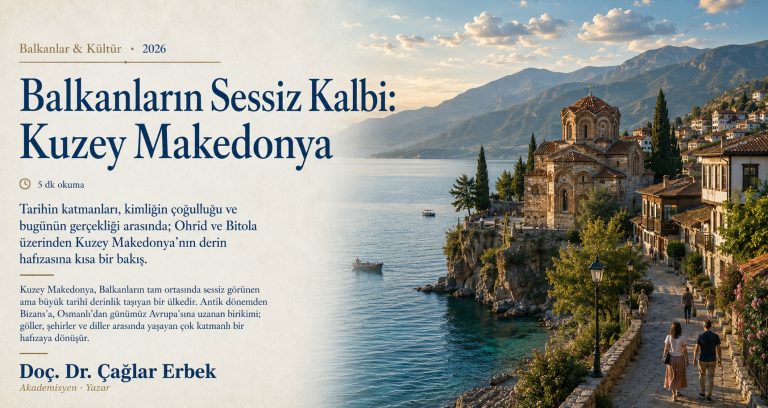
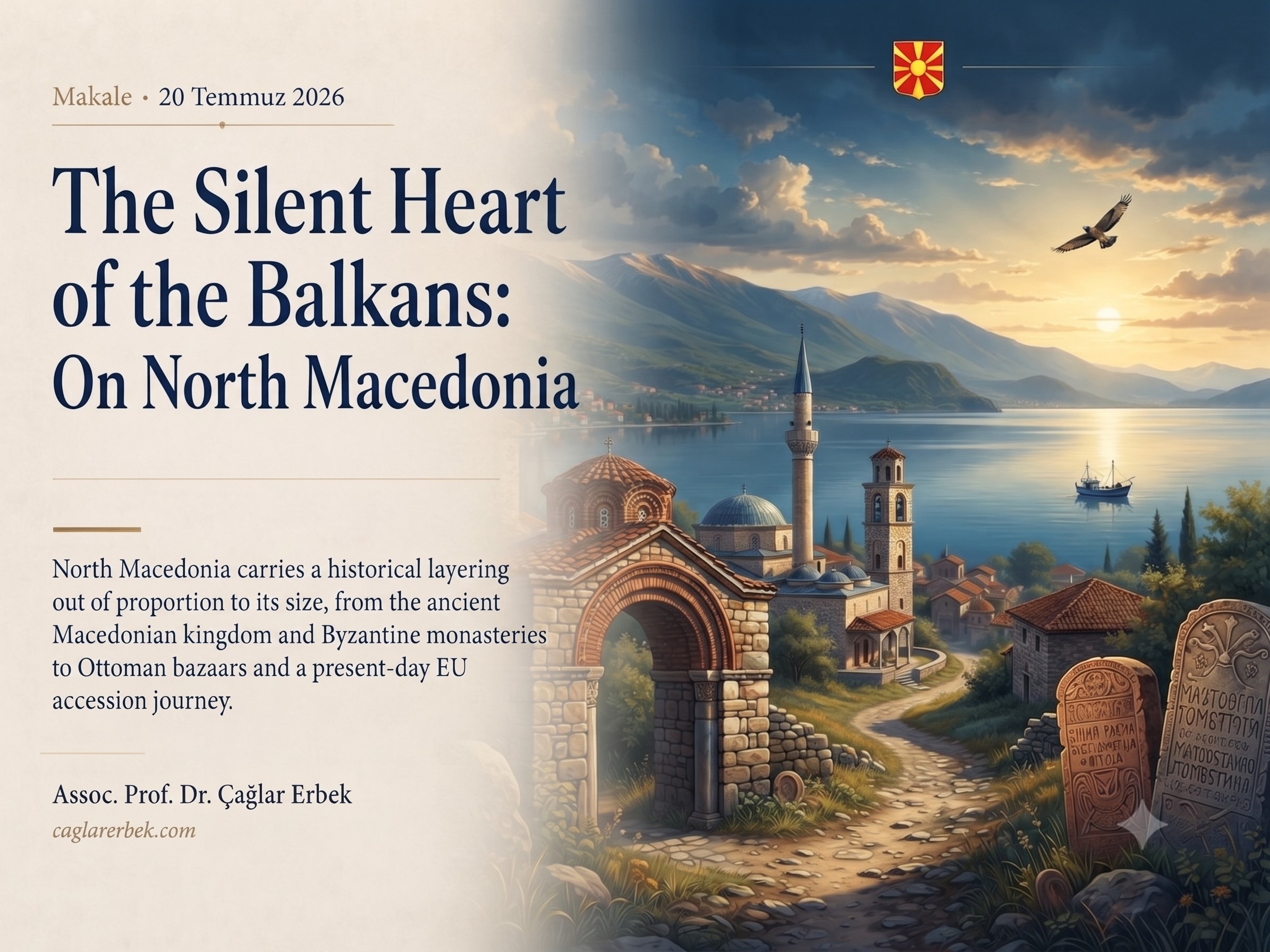
North Macedonia occupies the very centre of the Balkans, yet it remains one of the region’s least examined countries. It has no coastline, a population of just over two million, and was compelled only recently to change its own name. But behind this apparent quietness lies a geography that carries some of the densest historical layering in all of Europe — from the ancient Macedonian kingdom and Byzantine monasteries to Ottoman bazaars and a present-day journey toward the European Union. Its depth is entirely out of proportion to its size.
This essay attempts to introduce North Macedonia through three interlocking lenses: the accumulation of its history, the plurality of its identity, and the tensions of its present. Two cities serve as natural reference points throughout: Ohrid and Bitola. One is the spiritual capital of the country; the other was among the most cosmopolitan cities of Ottoman-era Balkans. Together, they function as mirrors reflecting the whole.
A Country Built on Layers
The territory of North Macedonia has never belonged exclusively to a single civilisation. It was the cradle of the ancient Macedonian kingdom, a Roman corridor, a Byzantine cultural heartland, and for more than five centuries an integral part of the Ottoman world. Each era left something behind without fully erasing what came before it. The result is a rare depth — civilisations not replacing one another so much as settling, one upon the next.
Ohrid is the most concentrated expression of this layering. Situated on the shores of one of Europe’s oldest and deepest lakes, the city became, in the ninth century, the birthplace of Slavic literacy. It was here that Saints Clement and Naum established a theological academy and systematised what would become the Cyrillic script — an alphabet used today by hundreds of millions of people across the globe. The Church of Saint Sophia and the Monastery of Saint Naum preserve some of the finest surviving examples of Byzantine art in the Balkans. UNESCO has recognised Ohrid as both a natural and cultural World Heritage Site, an acknowledgement of a significance that is genuinely difficult to overstate.
Bitola carries a different but equally substantial historical weight. Known as Monastir during the Ottoman period, it was by the late nineteenth century one of the most cosmopolitan cities in the Balkans: a place where Turkish, Greek, Jewish, Serbian and Albanian communities lived alongside one another, where European consulates lined the main boulevard, and where cultural diversity found an unusually vivid spatial expression. Mustafa Kemal Atatürk received part of his military education here; a monument and museum bearing his name still stand in the city. Bitola belongs not only to Macedonian history but to the shared memory of the wider region.
“In places where history accumulates in layers, every stone speaks more than one language. North Macedonia is such a place.”
The Inheritance of Plurality: Identity and Coexistence
One of North Macedonia’s most distinctive characteristics is that its ethnic and linguistic diversity has not receded into the past — it remains a living reality of everyday life. Macedonian Slavs constitute approximately sixty-four percent of the population; Albanians around twenty-five percent; Turks roughly three percent. Serbs, Roma, Bosniaks and other communities account for the remainder. These are not merely statistical categories: they map onto language, culture, institution and daily practice.
The Turkish community of North Macedonia represents one of the most sustained examples of cultural continuity in post-Ottoman southeastern Europe. Rooted in the Ottoman period and unbroken across successive political systems — the Kingdom of Yugoslavia, socialist Yugoslavia, and the independent republic — it has preserved its language, its institutions, and its collective memory across generations. Schools offering instruction in Turkish, local media broadcasting in Turkish, and entire neighbourhoods where Turkish is the primary language of daily life: these are not the remnants of a preserved heritage, but the expressions of a living continuity.
This plurality has not always been without friction. The armed conflict of 2001 — between Albanian insurgent groups and the Macedonian state — exposed the structural tensions that had accumulated beneath the surface of coexistence. The Ohrid Framework Agreement that ended the conflict established principles of minority language recognition, proportional representation in public institutions, and decentralisation of governance. It is not a perfect settlement, but it represents the choice of negotiation over fragmentation — and that choice itself is significant. In North Macedonia, plurality is not a solved problem; it is a continuously renewed equilibrium.
North Macedonia Today: In the Middle of the Road
In 2019, North Macedonia joined NATO and, through the Prespa Agreement signed with Greece, formally adopted its current name, resolving a dispute that had blocked its Euro-Atlantic integration for nearly three decades. Accession negotiations with the European Union opened in 2020. The country now finds itself in the midst of one of the most consequential transformation processes in the post-Cold War Balkans.
The costs have been real. For a significant portion of Macedonian society, relinquishing the name ‘Macedonia’ — even in favour of ‘North Macedonia’ — carried the weight of an identity wound. The referendum on the agreement failed to reach the required participation threshold and was confirmed by parliamentary vote, a fact that reflects the depth of the ambivalence. At the same time, support for EU membership remains high among younger generations, for whom it represents concrete possibilities: freedom of movement, access to education, an improved investment climate. Alongside this, however, high youth unemployment and emigration toward Western Europe — particularly Germany and Austria — constitute the most pressing structural challenge the country faces.
Bitola encapsulates this tension with particular clarity. The trajectory from the magnificent Ottoman Monastir of the nineteenth century, through the industrial city of socialist Yugoslavia, to the quiet and somewhat melancholy Bitola of today, traces the arc of North Macedonia’s broader condition. At the centre of the city, the Sinan Pasha Mosque and the bell tower of a nearby church stand within sight of one another — not as symbols of confrontation, but as evidence of time accumulated and not erased.
“North Macedonia has been living with questions that the modern world is still struggling to formulate: How is identity preserved through transformation? How is coexistence sustained across difference? What does a modernity rooted in history actually look like?”
Conclusion: A Small Country, a Substantial Meaning
North Macedonia carries a historical weight entirely disproportionate to its size. Ancient alphabets, Byzantine frescoes, Ottoman markets, cosmopolitan urban memories, multilingual social fabric — these are not fragments of a distant past but constituents of a present that is still in conversation with its own depth. Lake Ohrid reflects the same light it has always reflected, above all the layers that have settled around it. To understand this country is one of the most productive ways to understand the Balkans — and to understand the Balkans is to confront questions that Europe has often preferred to leave unasked: how plurality is sustained, how history is carried rather than suppressed, how identity is held rather than performed. North Macedonia’s answers are imperfect. But the fact that it is still living these questions is itself a form of value.